Pages

Showing posts with label language. Show all posts

14.4.15

LEARNING THE LANGUAGE - A-Z Challenge


LEARNING THE LANGUAGE – Yes, I have learned Spanish – it would have been rude not to. I am a foreigner who chose to move here, and it’s a Spanish speaking island.
I don’t speak it perfectly by any means, but I can hold a conversation and shop without pointing - there's a limit to what you can convey with sign language.
I can also cope with most medical situations. By giving myself a crash course in medical-speak I even survived a week in hospital having a hip replacement after living here for only a year.
As hospitals go, the Clinica Verde in Las Americas - a private hospital that takes some national health patients - isn't a bad place to be incarcerated, though having a bed bath in a room with two other patients and no curtains was a novel experience!
.

Our lives are enriched by being able to talk to Spanish people as well as English, and I have sometimes helped our 10 year old neighbour with her English homework. For the next month I will also be helping her father learn English, and that's even more of a challenge, as his native tongue is Italian!
 Call me Professora Liz!  


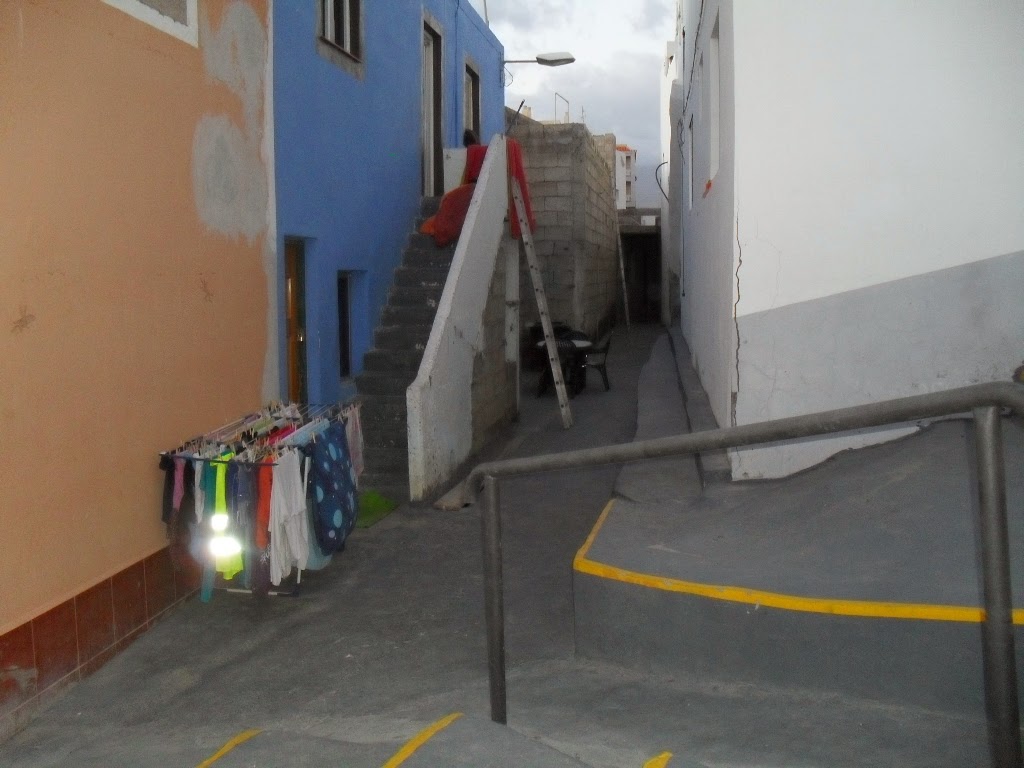
LAUNDRY – One of the advantages of life in Tenerife is that you very rarely need a tumble-drier, but not everyone has a terrace like ours, so they Leave their Laundry out on the pavement.  I took this photo in a back alley in Los Abrigos. It doesn't get much sun but the temperature was 30 degrees.

And this line of washing in Las Galletas gets the sun all day. There is also a graffiti'd line of washing on the wall behind it - a visual joke which always makes me smile.


... and, talking as we were of hip replacements, here's a bit of FLASH FICTION to finish with.

LOOKING AFTER MOTHER

My world has shrunk to this.
I should be grateful – they’ve decorated the room and hung pretty curtains. 
But the window is double-glazed, and although I can see the children throwing snowballs I can’t hear them.
I’m afraid to look in the mirror in case I’ve disappeared.

I wanted to go outside in the snow yesterday but I couldn’t find my boots, and I knew Edie had hidden them when she said, “You could break your hip, Mother, and then where would you be?”
In a nursing home is where I’d be, with other people to talk to.

Edie's gone out for a while - I think I’ll get my coat.

----------------------------------------------------------------------------------------------------
Thank you for reading - please leave a comment so I know you've been here!

13.4.13

LUKE, LABELS & LANGUAGE


LUKE FINCH is only seven when we first meet him in my novel Helter-Skelter. He is the brother of Bessie, the girl I mentioned yesterday who was scathing about Dot Smith’s kitchen.
Luke is a typical little boy, who lives half in the real world of Pinetree Farm and half in fantasy land, where he can be Charles LINDBERG flying solo across the Channel, or a racing driver breaking the world speed record. He is an Indian Scout when he tracks his sister and witnesses something that enables him to save his hero Albie from her machinations.
I was seven when my brother Luke was born. He was a doctor when he died 34 years later in a plane crash in Africa. I remember that Luke, of course, but I also remember him as a little blond boy, just like Luke Finch.


LABELS ARE LIMITING. What exactly does LITERARY mean in the writing world? We’re advised to check out an agent before submitting, and the word literary has always puzzled me.
Last year I completed a book about a young LABOURER who rescues an abused boy, and how that Strange Adoption changes both their LIVES. A professional critic called it “part psychological thriller, part a story of human growth.” If I can’t fit it into a category, how can I pitch it to an agent?


LANGUAGES. When we arrived here to live we had to learn Spanish quickly, because we were buying our apartment privately from a couple who spoke no English. If we were meeting Juan and Carmen to discuss our purchase I would write it all down in advance so I could read them my notes if we got stuck.
It was a tense time, renting in Las Galletas and knowing we’d shot our bolt financially if it all went wrong. I bought a set of flash-cards that reminded me of teaching my son to read, and we tested each other in the evenings. 
Ayuntamiento was our first long word – it means Town Hall, where we had to go for some of our paperwork - ( it also means sexual intercourse, according to my dictionary!) Many words have two or more meanings, and often only an accent differentiates between them. The OH learned the hard way to say “Feliz Año” – Happy New Year – with the ñ as in España. Without the accent, ano means arse! 
Aren't languages fascinating?

..... and for your LAST photo of the week, this is a LANTANA. They come in various colours, of which this is the most common here. When my daughter came to live in Tenerife 20 years ago, the first cutting I took home was a lantana, which flourished in my English garden, even through snow.


10.4.12

IDIOMAS & ITALIANS


IDIOMAS = LANGUAGES. When we arrived here to live we had to learn INSTANT Spanish, because we were buying our apartment privately from a couple who spoke no English. If we were meeting Juan and Carmen to discuss our purchase I would write it all down in advance – that way I could read them my notes if we got stuck.
It was a tense time, renting in Las Galletas and knowing we’d shot our bolt financially if it all went wrong. I bought a set of flash-cards that reminded me of teaching my son to read, and we tested each other in the evenings. Ayuntamiento was our first long word – it means Town Hall, where we had to go for some of our paperwork. INTERESTINGLY, it also means sexual INTERCOURSE, according to my dictionary! Many words have two or more meanings, and often only an accent differentiates between them. The OH learned the hard way to say “Feliz Año” – Happy New Year – with the ñ as in España. Without the accent, ano means arse! At times we regretted not opting for France, where we already spoke the language, but we got our Residencias and signed up for our apartment without any problems.
Old gits we may be, but when there’s a strong enough motive we can do anything.

Some of our first neighbours when we moved into our own apartment were a young ITALIAN man and his Ecuadorean wife. Paola spoke South American Spanish as well as Italian, but Massimiliano only spoke Italian, so we went through some of the Spanish-learning process together.
At my 60th birthday party they announced they were pregnant, amid great rejoicing. When the date was IMMINENT we discovered that their entire family INTENDED to descend on them for the birth – Paola’s mother, Massi’s parents and grandmother, and his uncle and aunt and cousin, and his best friend from Milan. For a whole month! How would they all fit into a two-bed apartment, I asked. Massi shrugged – they’d manage somehow for such an IMPORTANT occasion.
So we offered them our spare room. We got the uncle and aunt. A lovely couple about our own age with whom the OH and I communicated, in their Italian and our limited Spanish, with the aid of a ‘Seis-idiomas dictionario’ I’d picked up at a car boot sale. It’s INCREDIBLE what you can achieve if you set your mind to it.
The baby was beautiful - an olive-skinned, black-haired dumpling - and how the young mother coped with such a houseful, and the large dog her husband acquired before they met, I shall never know. When the family had all gone back to ITALY we became substitute grandparents. My Spanish IMPROVED in leaps and bounds, discussing breast-feeding and nappy rash and IN-LAWS with Paola.
Then a year later there was another INVASION when they all came back for the christening. There were about twenty children all being baptised in the IGLESIA at the same time, each of them with their own entourage of camera-wielding family and friends. It was total mayhem but the priest managed somehow, then we lined up for INNUMERABLE photos on the church steps, piled into whichever car was nearest, and went to a restaurant for a party that seemed more like a wedding reception than a baptism.
Roberta’s seven now and she calls me “Leez”. She makes allowances for my stumbling Spanish and brings crowds of her friends Trick-or-treating at Halloween - and I love it. She's the one on the left.

ILLEGAL IMMIGRATION is a problem that hits the newspapers at about the same time each year, presumably when the prevailing winds are right for crossing the hundred miles of open ocean between Africa and here. Desperate people pay large sums of money to be crammed into pateras (open wooden boats that are far from sea-worthy) and towed out into the Atlantic. If they are lucky, the owners of the motor boats set them adrift within sight of land. They are usually picked up by the Coastguard radar and escorted to a harbour, where the Cruz Roja checks their health and then they are bussed to a detention centre. Most of them are sent back, but they keep coming.
I have witnessed the arrival of two pateras in my time here – one actually came into Las Galletas harbour while I was shopping. On another occasion we were celebrating a friend’s birthday in Los Abrigos when, around ten pm, we saw lights approaching. An orange rescue boat escorted a patera into the harbour, and the restaurant owners sent down bread and bottles of water for the exhausted people in the boat. We watched the whole drama from mere yards away – Police, Ambulances, coaches. The patera itself was a wreck, half-full of water and food scraps, and brightly painted with a hopeful face and a saint’s name which must have been the only things that got it safely ashore.
We heard of one patera that didn’t get here at all. The human traffickers pushed the boat out to sea with no engine and it missed the Canaries entirely. The passengers wrote pathetic notes to their families as they died one by one. Weeks later the patera ended up in Bermuda. I believe it started out with 50 on board – they found 11 bodies.

ISLAND WEATHER. We live on an island you can drive round in a day, and the climate is odd. It could be raining in our village and sunny a kilometre away. We have been standing on our terrace in the sun and watched a curtain of rain sweep towards us across the swimming pool. That’s microclimates for you!

2.4.12

BARS & BANANAS


BARS. Love ‘em or hate ‘em, they’re the places to meet people, unless you’re into BOWLS or BADMINTON or BELLY-DANCING or can afford to join the BRITISH GAMES CLUB or play golf.
There is one English bar in our small town and four Spanish, so choosing which one to visit depends on which TV programme you want to avoid. BRITAIN’S GOT TALENT (hmm!) or The X Factor send us to a Spanish bar. BARCELONA playing Madrid is a good night to drink English and then shut ourselves indoors with the cat, away from the shouts and groans and the BANGS of fireworks.
 El BUHO is an odd place, frequented by a group of BULGARIAN deaf and dumb people. They came over here to sell novelty lighters in the tourist bars, which can’t earn them much as they live ten to an apartment, but presumably is an improvement on their former lives. Their language is silent, but the flickering of hands is strangely disturbing - my instinct is to ask them to keep the noise down, but one can hardly do that!
Strangely, I don’t find Spanish nearly as distracting, and often leave the OH at home while I repair to a coffee-bar - preferably overlooking the sea - to write in peace.

BASURA. At strategic points throughout the town there are wheelie BINS for basura (rubbish) and recycling bins for paper, glass and plastic. They are emptied every day. It’s a good system, much better than having a set of bins for every home that are only emptied once a fortnight, yet there are still people who complain at having to walk those extra few yards, and dump their rubbish wherever they please. There's a B word for them, but it escapes me for the moment!

BANANAS. One of those words that is difficult to stop spelling! The first time I flew into Tenerife, I looked down from the plane window and wondered what the huge sand-coloured areas were. Now I know they are covered banana plantations, and we eat the produce every day. Each banana plant produces one enormous red flower, and the petals curl back to reveal rows of tiny bananas. These grow until eventually there is a bunch of bananas it takes a strong man to lift. I once heard a disgruntled Englishman complain that they were too small. At 50c a kilo, eat two!

BEFORE I sign off for today, thank you to all those who looked at my blog, and especially those kind people who commented.